
In the early 1960s, while America wrestled with segregation and the Civil Rights Movement, one of its greatest literary voices was writing not in Harlem or Paris but in an apartment in Istanbul.

On an October evening in 1961, someone knocked on the door of a lively apartment in Istanbul. Inside, Turkish actor Engin Cezzar and his wife, the celebrated actress Gülriz Sururi, were hosting one of their regular gatherings. The rooms were filled with playwrights, painters, journalists, actors, and academics, the kind of evening where theatre, politics, and literature blended into conversations that lasted until dawn.
Standing at the door was James Baldwin.
He hadn’t written to say he was coming. He simply arrived with a suitcase in one hand and an unfinished manuscript in the other. According to those who remembered that night, Baldwin was so exhausted from his journey that he eventually fell asleep during the gathering. Yet no one in that apartment not even Baldwin himself could have imagined that the unexpected visit would grow into one of the most important chapters of his life.

Today, James Baldwin is remembered as one of the defining voices of twentieth-century America. His essays dismantled the myths of race, religion, and identity, while novels like Go Tell It on the Mountain, Giovanni’s Room, and Another Country transformed American literature. His life is usually mapped through Harlem, Paris, and the Civil Rights Movement.
Rarely does Istanbul appear on that map.
And yet, between 1961 and 1971, Baldwin returned to Türkiye again and again. What began as a short visit became a decade-long relationship with a city that offered him something increasingly difficult to find elsewhere: privacy, friendship, and the freedom to write.
A Writer Running Out of Breath

By the early 1960s, he was no longer simply a novelist. America expected him to be a spokesman for Black Americans, an interpreter of racial injustice, and a moral voice during one of the country’s most turbulent decades. As his public profile grew, Baldwin was increasingly called upon to interpret America’s racial divisions and moral contradictions.
At the same time, he was trapped inside a novel he could not finish.
For years, Another Country had resisted completion. Friends remembered him as physically exhausted, emotionally drained, and financially struggling when he arrived in Turkey.
Why Istanbul?

The answer wasn’t political. It was personal.
Baldwin had met Engin Cezzar several years earlier in New York while working on a stage adaptation of Giovanni’s Room. The two became close friends, and Cezzar extended a simple invitation:
“If you’re ever in Turkey, come.”
In 1961, Baldwin finally did.
“Turkey Saved My Life.”
Years later, Baldwin would summarize that period in a sentence that has since become inseparable from his Turkish decade:
“Turkey saved my life.”

The words were not about escaping America forever. Baldwin never stopped writing about his country, nor did he abandon the Civil Rights Movement. Instead, Turkey gave him something America no longer could: enough distance to see it clearly.
“I can’t breathe,” Baldwin once told his friend and Turkish journalist Zeynep Oral. “I have to look from the outside.”
That distance changed everything.
Within weeks of arriving in Istanbul, Baldwin completed Another Country. After years of frustration, the manuscript was finally finished.
At the bottom of the final page, he wrote five simple words:
Istanbul, Dec. 10, 1961.
How Istanbul Welcomed Baldwin
What Baldwin found in Istanbul was not celebrity.
It was community.

Through Engin Cezzar and Gülriz Sururi, he was introduced to some of Türkiye’s most influential cultural figures. Novelists, painters, actors, directors, journalists, and intellectuals welcomed him into their homes and conversations. Among the people he encountered were novelist Yaşar Kemal and artist Aliye Berger, two of the most important names in modern Turkish culture.
No one expected him to represent America.
No one demanded that he become the voice of Black America before he sat down for dinner.
To his friends, he was simply Jimmy.
That difference mattered.
For perhaps the first time in years, Baldwin could be known first as a writer, not as a symbol.
The City That Asked Nothing in Return

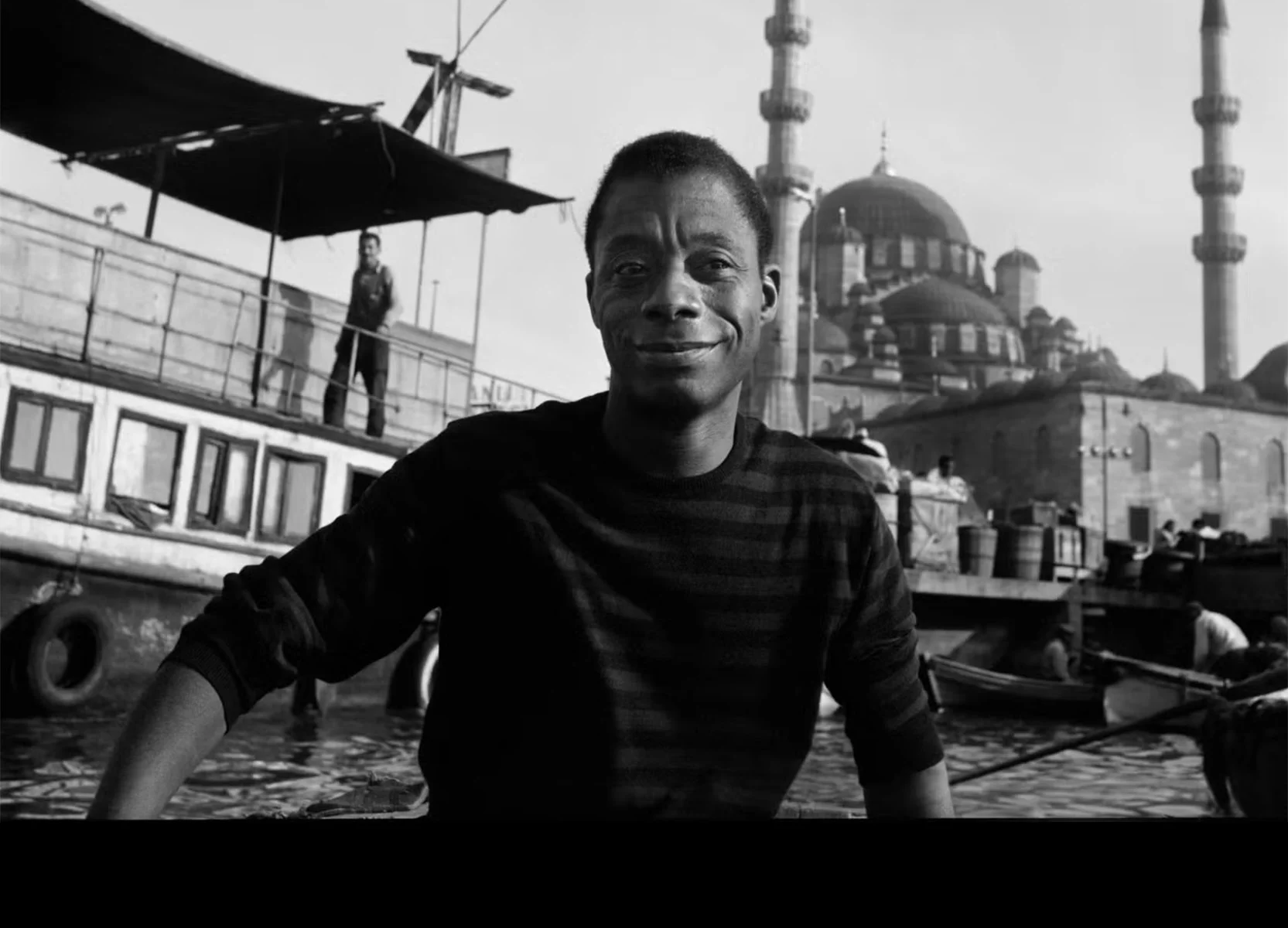
There is a reason so many photographs of James Baldwin smiling come from Istanbul.
The young Turkish photographer Sedat Pakay captured him walking through Beyoğlu, laughing with friends, drinking tea, riding ferries across the Bosphorus, and sitting quietly at work. His documentary James Baldwin: From Another Place reveals a version of Baldwin rarely seen in American television interviews, a man who appears relaxed, playful, and unguarded.
Baldwin once observed that living in another civilization forces a person to question assumptions they never knew they carried. Istanbul did exactly that. Rather than pulling him away from America, it sharpened his understanding of it. Distance became a way of seeing more clearly.
James Baldwin Through Turkish Eyes

Years later, Turkish novelist Yaşar Kemal remembered Baldwin telling him, “Yaşar, I feel free in Turkey.” Kemal’s reply was as memorable as Baldwin’s confession: “That’s because you are an American.” Their brief exchange revealed the different meanings that freedom could carry for two writers shaped by very different histories, yet united by a shared belief that literature should confront injustice rather than look away.
More Than a Footnote
For decades, Baldwin’s years in Türkiye were treated as little more than a curiosity in his biography. Today, scholars see them differently.
Without Istanbul, there may never have been the Baldwin who completed Another Country, found renewed creative confidence, directed theatre, or continued producing the work that would cement his place among America’s greatest writers.

History remembers James Baldwin standing before microphones in New York.
Literature remembers him writing in Paris.
But part of his story belongs to Istanbul, a city that did not ask him to become someone else.
It simply became a home where he could be himself.



Leave a Reply