
Every civilization leaves behind a way of seeing the world. Art is where that vision becomes visible. Ottoman and Renaissance art emerged during the same centuries, yet they developed profoundly different ways of representing the world. Venetian painters worked in Istanbul. Ottoman sultans collected and commissioned Italian portraits. And yet the paintings themselves look like they come from different centuries, not just different courts. Understanding why requires looking past style and into the underlying philosophy each tradition was built on.

Two Different Goals for a Painting
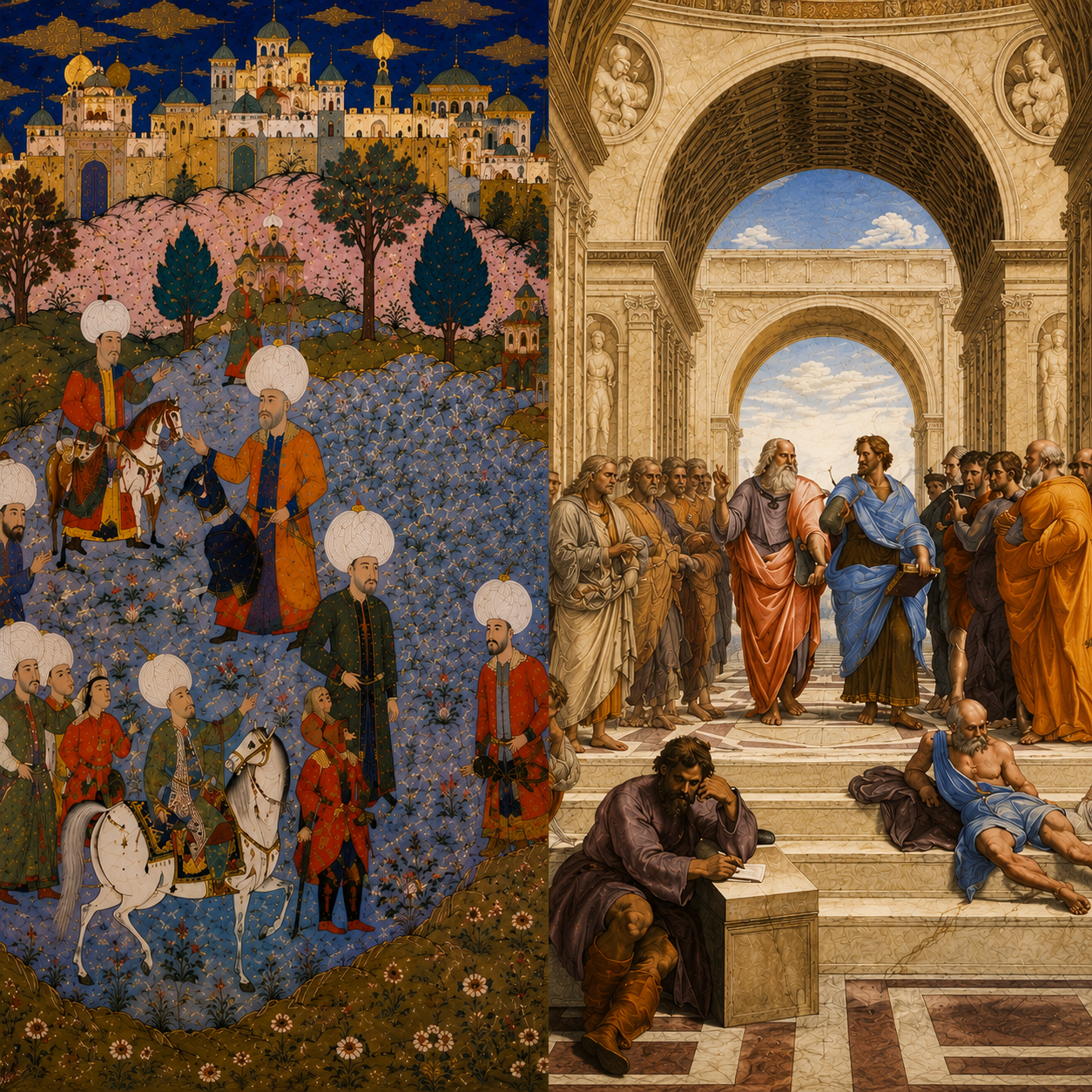
The single biggest divide between Ottoman and Renaissance art isn’t technique , it’s purpose. Renaissance painting set out to convince the eye that it was looking at the real world: depth, volume, a believable body standing in a believable room. Ottoman painting was after something else entirely.

Ottoman miniature painting followed a collaborative process. A master artist planned the composition, apprentices prepared the outlines, and colorists completed the work. Rather than creating optical depth, the emphasis was on clarity and narrative. That omission wasn’t a technical limitation, it was a choice rooted in belief. Ottoman artists were generally less concerned with strict realism than their Renaissance counterparts. Their goal was not to recreate the visible world with optical precision, but to communicate narrative and meaning. Some scholars see this approach as reflecting broader Islamic and Sufi ideas about the transient nature of earthly life, although the subject remains debated.
Renaissance artists were chasing the opposite conviction: that the visible world, rendered with enough precision, could reveal something true and even divine. Ottoman artists were reaching past the visible world entirely, using stylization rather than illusion to gesture at it.

Perspective: A Window vs. A Map
Renaissance art is famous for linear perspective, the vanishing-point system that lets a flat panel convince you it has real depth, as though you’re looking through a window into another room. Ottoman miniature painting rejected that system almost entirely, and not by accident.

Space in Ottoman miniatures followed its own logic. Buildings could be shown from multiple viewpoints, and different moments of a story could unfold within the same image. Rather than recreating a scene as it appeared to the eye, artists arranged space to guide the viewer through the narrative. Renaissance painters generally pursued the opposite goal: representing a single moment from a coherent viewpoint.

Rather than pursuing realism or linear perspective, Ottoman miniatures leaned into flat picture space, dense detail, symbolic content, and geometric pattern to carry the story. The image wasn’t a window. It was closer to a diagram of meaning.
Function Shaped the Form
Part of the difference comes down to what each kind of art was actually for. Ottoman miniatures were made to document military campaigns, court ceremonies, historical and religious episodes functioning less as standalone aesthetic objects and more as illustrations bound tightly to the text they accompanied. A miniature’s job was to record and narrate, not to stand alone on a wall demanding contemplation the way an altarpiece or portrait did.

Ottoman miniature painting developed from the Persian tradition but gradually acquired its own character. Court manuscripts increasingly emphasized historical events, imperial ceremonies, and military campaigns with remarkable attention to detail. Renaissance painting, by contrast, evolved as an independent work of art signed by individual artists, collected by patrons, and admired for its technical and aesthetic qualities.
That difference in function even shows up in authorship. Ottoman miniatures were essentially never signed, partly because the artistic tradition rejected individualism as a value, and partly because the finished image was rarely the work of one hand alone. Renaissance Italy moved in the opposite direction toward the artist as a named, celebrated individual genius, a Michelangelo or a Bellini whose personal style was itself the selling point.
Color and Surface

Even the palette reflects the two traditions’ different priorities. Ottoman miniatures relied heavily on bright red, scarlet, green, and various shades of blue, bold, flat, decorative color chosen for clarity and symbolic weight rather than to model light falling across a three-dimensional form. Renaissance painters, chasing volume and atmosphere, built their palettes around shading and gradation: the whole point was to make color behave like light.
Contact Without Convergence
None of this means the two traditions developed in isolation. Ottoman rulers and Renaissance artists were in genuine dialogue, most famously through the Ottoman court’s engagement with Venetian painters like Gentile Bellini. Some Ottoman court painters even experimented directly with Western techniques. A Sultan’s portrait attributed to Şiblizade Ahmed uses Western-style shading to build a sense of volume around the face and turban, a striking departure from the flat, unmodeled planes that had defined Ottoman painting up to that point.

But these were experiments at the margins, not a wholesale shift. Scholars increasingly frame the Ottoman Empire’s own artistic flowering spanning architecture, Iznik tilework, calligraphy, and manuscript painting from the early 15th through the 16th century as a genuine renaissance in its own right, distinct from Italy’s, rather than a delayed echo of it. The Ottoman world wasn’t behind the Italian Renaissance or reacting to it. It was pursuing its own definition of artistic rebirth, built on its own sources, Timurid, Persian, Byzantine, and Islamic and answering to its own questions about what a picture is supposed to do.
The Real Difference
Renaissance art asked: how do we make this look real? Ottoman art asked: how do we make this mean something? One tradition built its authority on the illusion of a window into the world. The other built its authority on pattern, narrative, and a deliberate refusal to mistake the image for the thing itself.
Neither approach was a step toward the other. They were two different, fully realized answers to the same underlying question “what a painting owes to the world it depicts” arrived at by two empires that were, at times, looking directly at each other’s work while building something entirely their own.




Leave a Reply